Celebrating a Legacy in the Coton de Tulear
Connie Fox of Fluffy Acres Cotons
by Tracy McSherry-McKown 2026
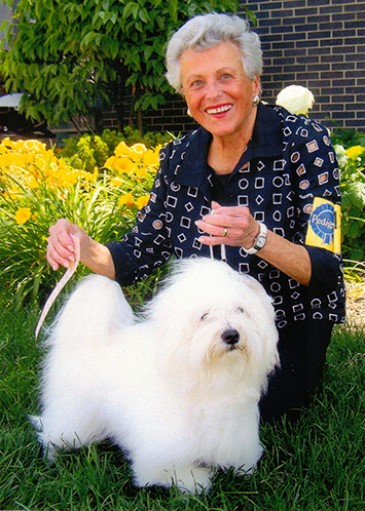
For Connie Fox of Fluffy Acres, the Coton de Tulear has been more than a breed—it has been a lifelong passion, a source of joy, and a legacy shaped over decades. Pictured here with her beloved Princess Calleigh, Connie represents a generation of breeders devoted to preserving the heart and soul of this remarkable companion dog.
Now at 96, Connie reflects on a journey that began with a chance encounter and grew into a deep commitment to preserving what she calls “the perfect dog.”
Connie’s introduction to the breed came unexpectedly at a dog show, where she met a breeder from Belgium (Micki Ceriez’s Woodland Cottage) whose Cotons immediately captured her heart. Having previously owned Golden Retrievers, she hadn’t been searching for a smaller breed—but practicality and fate aligned. “My husband thought it would be easier for me to handle a smaller dog,” she recalls. “But once I saw them, that was it.”
Her first Coton was far from a show dog—just a little black-and-white companion discovered through a simple newspaper advertisement. Yet that dog left a lasting impression, especially on her husband. “She was the love of his life,” Connie says with a smile. “They know exactly how to get what they want.”
In those early years, the Coton de Tulear in the United States looked quite different from the dogs we see today. Coats were less refined, and presentation standards were almost the opposite of modern expectations. “They didn’t want silky coats back then,” Connie explains. “If a dog was too clean, they wouldn’t show it. They’d actually let them get a little dirty.”
Over time, the breed has evolved—sometimes in ways Connie views with caution. One of her guiding principles has always been to protect the breed from becoming too popular. “Whenever a breed gets very popular, it gets ruined,” she says plainly. Her concern centers largely on health and irresponsible breeding practices that often follow demand. “People who don’t know what they’re doing start breeding, and it becomes about price instead of quality.”
For Connie, temperament has always been the defining trait of a great Coton. “Temperament and personality—those are everything,” she says. “They just blossom with personality. You can’t help but fall in love with them.”
Throughout her years in the breed, certain dogs have left an indelible mark. She speaks fondly of Jazz, a Grand Champion and World Champion who lived to 17. His passing remains a vivid and emotional memory. “He was all over the world,” she says. “I just loved him.”
As the breed has grown, so too have the complexities of breeding practices and health testing. While Connie acknowledges the value of health screening, she worries that it may be going too far. “There’s a balance,” she explains. “You try to eliminate one problem, and sometimes something else comes back around.” She is equally cautious about breeding strategies, advocating for thoughtful pairings without excessive inbreeding.
One of the biggest challenges she sees today is educating puppy buyers. Too often, she says, people prioritize cost and convenience over quality and responsible breeding. “People don’t want to wait, and they want something cheaper,” she says. “But you get what you pay for.” She encourages buyers to seek out reputable breeders and understand the value behind a well-bred dog.
Despite the challenges, Connie’s memories are filled with joy and humor. One story she shares involves a reluctant breeding pair—and a male dog named Charlie who, after much confusion, finally figured things out on his own. “He had the biggest smile on his face,” she laughs. “We were hysterical.”
When asked how she would describe the Coton de Tulear to someone unfamiliar with the breed, Connie doesn’t hesitate: “They’re the perfect dog.” From their non-shedding coats to their manageable size and affectionate nature, she believes they offer everything a companion should be.
Her hope for the future is simple, though not without concern—that the breed can retain the qualities that make it so special. “There will always be people who breed just for money,” she says. “I don’t know how you stop that. But we have to try to keep the good ones going.”
After more than six decades with dogs, Connie is certain of one thing: the Coton de Tulear has given her everything. “The biggest joy in the world,” she says.
Her advice to breeders is rooted in experience and care: set puppies up for success, provide proper veterinary care and nutrition, and be honest about which dogs are suited for show versus companionship. Above all, she emphasizes responsibility and integrity.
“The Coton de Tulear is the perfect dog,” Connie says. “Let’s keep them that way.”